The New Burnout Doesn't Look Like a Breakdown. It Looks Like a Tuesday.
Apr 20, 2026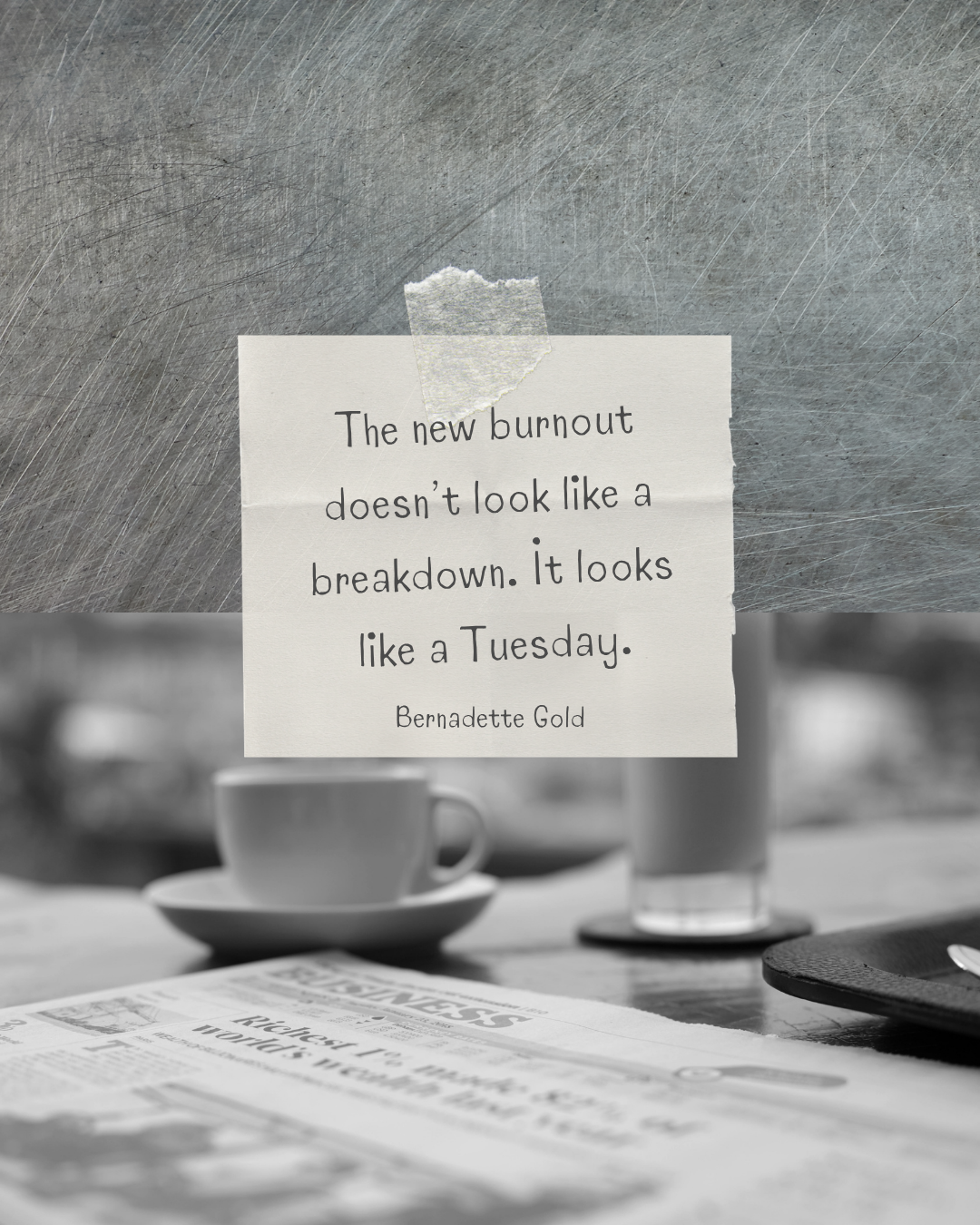
Burnout in 2026 is no longer driven by workload. It is driven by cognitive overload, fragmented digital tools, constant context switching, and the emotional cost of adapting to AI at a fast pace. The people most at risk are not the ones who are visibly overwhelmed. They look like you, on a Tuesday, hitting your numbers.
The version of burnout nobody is naming
The old version was easy to spot. Someone crashed. Something is wrong. HR had a playbook. The person had a name for what was happening.
The new version is almost invisible.
She is still hitting her targets. Still on every call. Still shipping the deck, writing the update, managing the direct report, answering the Slack, running the household, picking up the kid, answering the text.
And underneath it, something is quietly disappearing. Not dramatically. Not all at once. In very small amounts every day. The spark in the work. The curiosity that used to open at 8 a.m. The easy laugh. The thing that used to make the hard days feel like they were worth it.
This is the new burnout. It doesn’t look like a collapse. It slowly drains you and empties you out.
Why high achievers miss it
Because the numbers still work, and the system still rewards the output. Because the feedback loops only measure the visible layer. Because the person running it was trained, usually from a very young age, to treat discomfort as a signal to push harder.
Also, because the tools got sharper. AI now fills every crack in the day that used to be a breath. That second on hold while the next call connects, or the quiet minute before the Slack threads open. The walk to the next room is now a Zoom transition.
The day got denser. The mind has less room to process anything. The body is not recovering at the same speed as the calendar is consuming.
No single moment feels like too much. Every day, all those single moments, does.
The signal most high performers are missing
If you can still produce, the body's signal may not be a crash. It is a loss of texture. Colors feel flatter. Food is less interesting. The book you were halfway through has been next to the bed for six weeks. A good conversation is pleasant, but doesn’t connect.
That narrow band of feeling fine but flat, that is the signal. Not a crash. A slow hollowing. And most high achievers are trained to push straight through it.
It is not a personality change, or age. It is the body telling the mind that the energy input accounts are running low and no deposits are being made.
Most high achievers interpret it as needing to push harder. Or as a sign that the current role is the wrong role. It is usually neither. It’s usually a gap in recovery that no strategy can fix.
Pausing is not a retreat from performance
Nobody taught high achievers how to pause. The sacred pause is not a lack of motivation or laziness. It is not time away from work where you’re slacking. It’s the condition under which the work stays honest and honors the self.
There is an ancient principle called Wu Wei. It means effortless action. Moving with what is natural instead of against it. The most sustainable performance doesn't come from forcing. It comes from allowing. Rest. Process. Then act.
The pause reopens the loop. Solutions arrive without forcing. Intuition comes back online. Creativity returns. Recovery is not optional. Recovery is where the best thinking lives.
3 Things worth scheduling this week
- One hour a day with no input. Not a walk with a podcast. Not a drive with the radio on. One hour where nothing is being received. The body starts processing again the moment the input volume drops.
- One full meal where the phone is in another room. Not on the table face down. In another room entirely. The mind and the stomach cannot both do their job while a notification could arrive at any second.
- Start your day without your phone for 30 minutes. The first thirty minutes of the day shape the quality of thinking available for the next twelve hours. Give yourself back the first thirty.
None of these is a productivity hack. They are not additions to the list. They are the beginning of a different relationship with yourself.
The takeaway
If you are still producing, you are not necessarily fine. You aren’t used to measuring what's being depleted. The people around you will keep rewarding the output. The output is also what covers the signal.
Do the small recoveries now. Not as performance tools. As the condition under which a whole life stays available to you. That is the work the old model never taught. That is where the unshakeable version of you lives.
Bernadette Gold helps high achievers who are ready to go to the next level build success that actually lasts. Learn more at www.bernadettegold.com
Find out how I can help you.
Stay connected with news and updates!
Join our mailing list to receive the latest news and updates from our team.
Don't worry, your information will not be shared.
We hate SPAM. We will never sell your information, for any reason.
